Queer Places:
Belton Estate, High Rd, Belton, Grantham NG32 2LW, United Kingdom
Eton College, Windsor SL4 6DW, United Kingdom
University of Cambridge, 4 Mill Ln, Cambridge CB2 1RZ
St. Peter and St. Paul's Churchy, Belton, Grantham NG32 2LZ, United Kingdom
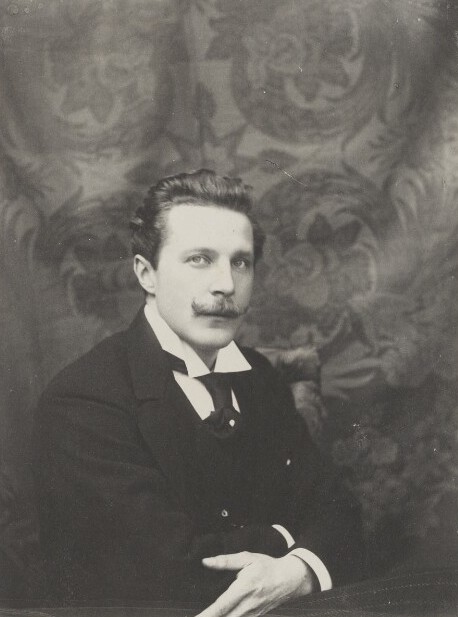 Henry John Cockayne-Cust (October 10, 1861 – March 2, 1917), born on October 10, 1861, was a prominent English politician, editor, and intellectual whose life epitomized the
brilliant yet eccentric spirit of the late-Victorian and Edwardian aristocracy. Coming from distinguished lineage, he was the son of Major Henry Francis Cockayne-Cust and
Sara Jane Cookson, and a younger grandson of Brownlow Cust, 1st Baron Brownlow, of Belton House in Lincolnshire. His education began at Eton College, where he distinguished
himself as captain of the Oppidans, before he proceeded to Trinity College, Cambridge. At Cambridge, he immersed himself in academia and elite intellectual circles, becoming
a member of the prestigious Cambridge Apostles and earning his Bachelor of Arts with second-class honors in the Classical
Tripos in 1884. Although initially admitted to the Inner Temple in 1888 with the intention of pursuing a legal career, he ultimately shifted his focus toward politics and
public life. Cust entered Parliament as a Unionist Member of Parliament by winning a by-election for Stamford, Lincolnshire, in 1890, serving until 1895, and later
representing the Bermondsey constituency in Surrey from 1900 to 1906. Alongside his parliamentary duties, he served as a Justice of the Peace for Bedfordshire and
Lincolnshire and as a Deputy Lieutenant of Bedfordshire.
Henry John Cockayne-Cust (October 10, 1861 – March 2, 1917), born on October 10, 1861, was a prominent English politician, editor, and intellectual whose life epitomized the
brilliant yet eccentric spirit of the late-Victorian and Edwardian aristocracy. Coming from distinguished lineage, he was the son of Major Henry Francis Cockayne-Cust and
Sara Jane Cookson, and a younger grandson of Brownlow Cust, 1st Baron Brownlow, of Belton House in Lincolnshire. His education began at Eton College, where he distinguished
himself as captain of the Oppidans, before he proceeded to Trinity College, Cambridge. At Cambridge, he immersed himself in academia and elite intellectual circles, becoming
a member of the prestigious Cambridge Apostles and earning his Bachelor of Arts with second-class honors in the Classical
Tripos in 1884. Although initially admitted to the Inner Temple in 1888 with the intention of pursuing a legal career, he ultimately shifted his focus toward politics and
public life. Cust entered Parliament as a Unionist Member of Parliament by winning a by-election for Stamford, Lincolnshire, in 1890, serving until 1895, and later
representing the Bermondsey constituency in Surrey from 1900 to 1906. Alongside his parliamentary duties, he served as a Justice of the Peace for Bedfordshire and
Lincolnshire and as a Deputy Lieutenant of Bedfordshire.
Beyond politics, Cust was celebrated as a magnetic conversationalist and a central figure in "The Souls," an elite and intellectually rigorous late-Victorian social
circle that included luminaries such as Arthur Balfour,
George Curzon, Margot Asquith, and his romantic interest Pamela Wyndham. In 1892, William Waldorf
Astor tapped him to edit the Pall Mall Gazette. Despite having no prior journalistic background, Cust rapidly transformed the publication into the premier evening journal of
the era by securing contributions from literary giants like Rudyard Kipling and H. G. Wells. However, his refusal to publish Astor's own literary submissions, combined with
underlying political friction, culminated in his dismissal in February 1896. Thereafter, he focused on poetry, such as his notable work "Non nobis," and dedicated himself to
governmental propaganda during the First World War by founding the Central Committee for National Patriotic Organizations in August 1914.
Cust's personal life was famously complex, marked by a reputation as a notorious womanizer and numerous romantic entanglements. On October 11, 1893, he married Emmeline
Mary Elizabeth "Nina" Welby-Gregory, an artist, translator, and daughter of Sir William Welby-Gregory, 4th Baronet. The union followed a purported pregnancy that proved
false or misrepresented, resulting in a contentious marriage that produced no children. Nina ultimately commemorated their complicated bond through an elaborate white marble
monument featuring a recumbent effigy of her husband at St Peter and St Paul's Church in Belton, where they are buried together. Despite having no legitimate heirs, Cust
fathered several children out of wedlock, most notably the celebrated socialite Lady Diana Cooper with his mistress Violet Manners,
Duchess of Rutland. He was also linked by persistent historical rumors to other aristocratic offspring and even theorized, though without factual proof, to be the maternal
grandfather of former British Prime Minister Margaret Thatcher.
As the senior male relative of his childless second cousin, Adelbert Brownlow-Cust, 3rd Earl Brownlow, Harry was the heir presumptive to the barony of Brownlow, the Cust
baronetcy, and the vast Belton House estates. However, because he predeceased the 3rd Earl by three years, having died of a heart attack on March 2, 1917, at his London home
in Hyde Park Gate, the inheritance bypassed his branch and passed instead to his surviving younger brother, Adelbert Cockayne-Cust, who became the 5th Baron Brownlow. Cust's
legacy persisted through his literary output, his memorial Annual Cust Lecture endowed at the University of Nottingham, and the detailed biographical exploration of his
scandalous and romantic world captured in Jane Dismore's Tangled Souls: Love and Scandal among the Victorian Aristocracy.
His connection to LGBTQ+ history and networks is anchored primarily through his membership in the Cambridge Apostles—a secretive, highly selective University of Cambridge
intellectual society founded in 1820 that historically fostered an environment of profound homosocial and homoerotic intimacy among its elite members, many of whom went on
to shape queer literary and cultural landscapes in Britain. Furthermore, Cust operated at the absolute center of late-Victorian aesthetic and aristocratic circles, such as
The Souls and the broader Marlborough House set, environments defined by sophisticated, fluid, and often unconventional social and romantic dynamics that frequently
challenged rigid Victorian sexual orthodoxies. Figures within his immediate orbit, including fellow intellectuals, writers, and aristocrats, frequently navigated hidden or
non-conforming desires, aligning his social milieu closely with the emergent, sophisticated subcultures that predated modern queer visibility.
References:
Other references:
- Oxford Dictionary of National Biography (ODNB), Damian Atkinson, "Cust, Henry John Cockayne". This provides the definitive academic and biographical overview of his life, political career, and editorship.
- Tangled Souls: Love and Scandal Among the Victorian Aristocracy by Jane Dismore (The History Press, 2022)
- Alumni Cantabrigienses: A Biographical List of All Known Students, Graduates and Holders of Office at the University of Cambridge, from the Earliest Times to 1900 compiled by John Venn and J.A. Venn (Cambridge University Press, 1922–1958)
- Oxford Book of English Verse (1250–1900) edited by Arthur Quiller-Couch (Clarendon Press, 1919)
- Hansard Debates in Parliament
- The Marlborough House Set by Anita Leslie (Doubleday, 1973)
- Find a Grave & Parish Registers (St Peter and St Paul's Church, Belton, Lincolnshire)
Support this project
This website is a passion project researched, developed, and funded entirely by me. If you find the content valuable and would like to help support the ongoing research and hosting costs, any contribution is deeply appreciated.
Thank you for keeping this independent resource alive!
My books on Amazon: Elisa Rolle's books
BACK TO HOME PAGE
